Saturday, March 26, 2016

An Introspection

Hello and welcome again to the next installment of my blog!

Admittedly, this week has been pretty quiet at the museum, especially after the madness that was last week. Once the spring break of the Mesa public schools finished, the museum went back to the usual throngs of younger children. However, school groups are still coming to tour the gallery in droves, and I have thereby become a pro at assisting with the tour activity, a variation of the printing activity that occurred with the Hokusai class that I mentioned in the previous post. And that means that I get paint on my hands. A lot. 

As we are in the second half of our project timeline already, I would like to take this time to broadly sketch out my plans for the remainder of the project. 

In terms of the museum, I will continue to do what I do now, which is primarily assisting with the tour, especially with the painting and printing at the end of each tour. At some point, I will begin to lead a tour stop or two, helping to educate the tour groups on the topics of recycling, the oceans of the world, categorization of marine animals, or echolocation. This will definitely be a different experience for me, as I'm not the best public speaker. However, the task seems less daunting when the audience is more interested in the art on display than what I'm saying. 

If I've learned anything from interning at the museum, it's that kids have a strange, unpredictable, wonderful insight. Even with my previous exposure as a TA to fifth graders, this is the first time in my life that I've had so much time close to such a younger generation. (I should mention that I also underestimated the collective destructive power of kids under the age of six. I will never make this mistake again.) As such, I am planning some sort survey as I mentioned in the post before. I have a prototype of one, but I'm contemplating having two: one for teenagers or adults, and the other for children. In any case, some form or either can hopefully begin to circulate next week at the museum. 

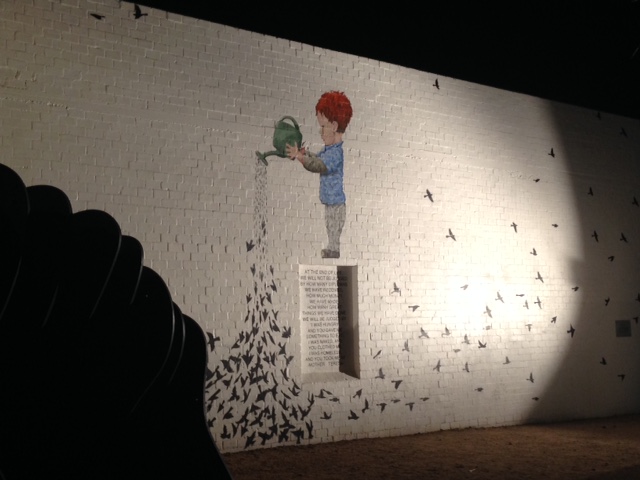
As for outside the museum, I find that I don't go to other sources of public art enough. However, I plan on visiting Roosevelt Row again--this time in the daylight, a piece known as Her Secret is Patience in Downtown Phoenix, and perhaps a couple of other works on the list that can be found here: http://dtphx.org/2015/10/01/9-public-art-projects-in-downtown-phoenix/.  

Her Secret is Patience
I really want to experience more of the city I've lived in for ten years, especially because there's a strong chance that I'll be leaving soon. Therefore, I'll spending the remaining weeks going out and not just photographing art, but also exploring the spirit of the city. Stay tuned for more photos of local public artwork! 


Saturday, March 19, 2016

A Return to Normalcy

Long time no see! I hope you all had a great spring break--I sure did. But this week marks a return to the museum where I have been interning, and it felt great to be back.

To get this out of the way first, below are a few pictures that I promised from the previous blog post:


The description here is too small to make out, but if you'd like more information on the project you can visit http://streetpianos.com/mesa2016/. 

The first picture above is of the piano that sits directly in front of the i.d.e.a. Museum. As you can see, it's pretty fancifully decorated, as are all of the pianos in this art project. I'm not sure if the coordinator of the project took the location of each piano into account when deciding where to place which, but I often wonder if the piano we got was reinforced, as I mainly see younger kids banging on it. And I only say this because I doubt pianos in other locations get so much wear and tear. 

Below that image is a large chalkboard-esque mural that seems portable as I did see this when I visited the Mesa Performing Arts Center two weeks ago. I believe that it's covered in different people's feelings on the pianos, and based on the change in locations, I think it also accompanies different pianos at different times. I particularly like this piece because of the giant and seemingly random pug head, but to see a physical manifestation of Mesa's affection for the pianos is a powerful reminder of just how far-reaching the project is, even if you see the mural next to only one piano. I would say that this is a great companion piece to the pianos, especially if it is circulating among them. I'll let you know if it's still there next week!

In other news, while at the museum I've had the opportunity to work increasingly close with visitors. More specifically, I help with tour groups coming through, assisting with the educators in the ocean-themed gallery and especially helping out with the ocean activity, which is a variation of the printing that was done in the earlier Hokusai class. Besides that, I've helped out with the odd class or two as well as the spring break program that was occurring this week (for some reason, Mesa's spring break is a week later than the Scottsdale one).

A child's "bubble" project from the spring break program.
A coral prototype I made for a class. 
Aside from that, I've picked up a book from the museum library on Keith Haring, who just so happens to be a prolific public artist. For next week's post, I might do an exploration into process and legacy, as a lot of his work embodied an extremely straightforward principle of egalitarian public art. 

And finally, I'm deciding whether or not to survey people at the museum on public art. Since many of the frequenters are children, the responses would mainly consist of parents and teachers, which could prove interesting. Please let me know what you think in the comments! 

As always, thank you for reading, and see you next week. 


Friday, March 11, 2016

Spring Break

Greetings from Florida! I hope you have a great week and I'll see you in next week's post.

Saturday, March 5, 2016

Music to My Ears (And Eyes)

Hello and welcome to my fourth week of my Senior Research Project!

Right as I walked into the museum as I do every Tuesday, I happened to notice a strange new acquaintance sitting at the entrance: an elaborately decorated piano. With hieroglyphics emblazoned on the back, knobs and meters on the front, and a rocket taking off from the top complete with a veritable cloud of exhaust, it was a hard sight to miss. Unfortunately, due to phone-shattering incidents, a picture of this beauty will have to wait until future posts.

After some digging (and the sign that said streetpianos.com, which I recommend you all visit), I found out that this piano is actually part of a larger public art series known as "Play Me, I'm Yours". Known more colloquially as "Street Pianos", the project is the brainchild of British artist Luke Jerram. From the website, the basic information is as follows:

"Mesa Arts Center is presenting Play Me, I’m Yours from March 1 until April 9 2016, as part of the celebrations of a major milestone: 10 years at their beautiful location in Downtown Mesa, AZ.  24 playable and artistically enhanced pianos will be featured, primarily in Downtown Mesa along Main Street, near Mesa museums and libraries, on Mesa Arts Center’s campus and at numerous other accessible and open-to-the-public locations, including several satellite locations throughout the city. The Twitter hashtag for the project is #streetpianosmesa."   

Physically, the pianos are placed at strategic locations throughout downtown Mesa: at the i.d.e.a. Museum, the Natural History Museum, the library, a whopping three at the Mesa Arts Center. In fact, if you just drive down Main Street, you're bound to see at least two stray pianos sitting near a mural or sculpture. But on the whole, the pianos are centered around places of education, which perhaps speaks to the importance of music education. This specific placement of the pianos calls to mind my previous post in which I looked into the importance of an environment of a public piece of art, which really serves to be the context for a piece of art. However, this week I would like to draw more attention to interactivity of the Street Pianos. 


Unlike the murals at Roosevelt, the Street Pianos in Mesa invite viewers to sit down and play--make music, brighten the atmosphere, draw other passersby. In fact, the pianos cross media--from the sculptural elements of the pianos themselves to the sounds they can emit. Whereas the mural conceptually required the viewers as a part of its existence as a public art piece, the pianos physically need people to sit and play--it's the whole purpose. This project is a prime example of art where there is no doubt of the art's relationship to the public. Accessibility is as easy spotting one of the pianos, sitting down, and deciding to hit some of the keys. And without players, the pianos seem somewhat diminished in their brightness, despite their cheerful facades. 

As mentioned before, a shattered phone screen has inhibited me from taking any photos. However, I promise them in a future post. In the mean time, if any of you are in Mesa some time soon, I highly recommend that you check the pianos out. Thanks for reading!


Friday, February 26, 2016

Gardens in the Downtown

Welcome to the fourth installment of my research project!

To kick off the third week of the trimester, I had the opportunity to view the official unveiling of a mural on Roosevelt Row in downtown Phoenix.


Titled "The Garden", this mural was made in conjunction with an organization known as the "I Have a Name" Project under the watch of founder and photographer Jon Linton as well as artists Brian Boner and Wayne Rainey. The unveiling of the piece was accompanied by a candlelight vigil for those who had passed away while homeless. 

This concurrence of events in particular brings to attention the singular intent of the work, which as I stated before is one of the hallmarks of public art. When a work of art can be exposed to a wide audience, it seems to be the best platform for igniting awareness among a large volume of people. To this end, Linton states 

"A west wall of the building will carry a message in humanity and compassion while the north facing wall shall list names of those lost to the street. The overall scope of this work intends to create a dialogue beyond the boundaries of this city and help motivate action that might end the human suffering that is homelessness." (Becker, 2015)

And the intent of Linton's message may be no better situated than at Roosevelt Row, an area populated by vivid and thought-provoking murals that are attraction in and of themselves. But the area itself begs the question of the environment around a specific piece of art. Similar to the dilemma of a tree falling in a forest with no people, if a piece of public art is created where it will not be seen, can it be considered public art? I am inclined to say no, as one of the key elements of public art is that of spreading a message, or at the very least an impression, from creator to audience. This belief can easily be applied to art across all media, but because the relationship between public art and the public is so intimate--and in some ways commonplace--it seems especially true. The role of people consuming public art is critical in a way that should be obvious because of the word "public" in the name, but maybe isn't considered as much when one is physically confronted with a piece. And though at the surface "The Garden" isn't by definition interactive, it was the vigil, the people who showed up to support and see the work, that transformed the piece from the representation of a message to a piece of public art. 

Just something to chew on. Thanks for reading and I'll see you in next week's installment! 

Source: 

 Becker, Katrina. "The Art of Awareness." Downtown Phoenix Journal. Downtown Phoenix Journal, 19 Jan. 2015. Web. 27 Feb. 2016. <http://downtownphoenixjournal.com/2015/01/19/art-awareness/>. 


Friday, February 19, 2016

Crazy Old Asian Men and Angsty Public Artists

As mentioned in my last blog post, this week I had the opportunity to help with an artist-focused class for homeschooled children. The artist that this class focused on was Katsushika Hokusai. For those of you less versed in Japanese artists, Hokusai is most well known for the print, "The Great Wave off Kanagawa": 


Hokusai revolutionized the art form of wood block printing that was so prevalent at the time of his career as an artist. Instead of using kabuki actors and courtesans as traditional subject matter, he depicted landscapes and ocean scenes in his distinctive style that eventually affected the course of art in both Japanese and western art.

Small history lesson aside, it was rather fortuitous that this particular artist was chosen for the class, both because his most well-known piece is within the ocean theme of the gallery and that much of his art can be considered public.

Unlike many of his contemporaries and the pervading "starving artist" trope, Hokusai gained much notoriety and fame during his career, rather than only after. This is due mostly to the fact that he was a genius at self-promotion. For example, he created a 600 foot portrait of a Buddhist monk named Daruma during a festival in Tokyo. His instruments? Buckets of paint and broomsticks.


Of course, some may deem this feat more of a spectacle than an example of respectable public art. However, this brings up an important question: what is public art?

From prior research, the most readily available answer is that public art is some form of visual art in a public (or otherwise easily accessible) location that serves a purpose. Now, the specific intent of the art is where the definition of public becomes sticky. Murals or large sculptures can easily be identified as works of public art, but what about advertisements, propaganda, or vandalism? Is Hokusai's giant portrait public art if the intent is motivated by selfish reasons? Can profit and government play roles in public art?

All signs point to yes. This is especially true after the Franklin D. Roosevelt's New Deal, which introduced government-commissioned art into public spaces. However, more recently, an onslaught of independent artists have done public pieces to create statements about the reality which we live in rather than create a piece for a company. This is essentially transforming the concept of public art, and is a testament to its fluidity and ambiguity as an art form.

To conclude, the following are examples of modern artists with public pieces:

Maya Lin's Vietnam Memorial

A piece by Jenny Holzer, with quite a literal message

A Covered Reichstag by Christo
As my research continues, I hope to explore the relationship between commercialism or politics with public art, as well as the egalitarianism of public art for both the creator and the audience.

Thank you for reading this week, and I plan to interview a local muralist for next week's entry! 

Bonus Hokusai class photos: 

My own print using styrofoam and a wooden stylus

A student's print

Part of a slideshow on Hokusai--the children were not as engaged at this point

A print by one of the I.D.E.A. Museum staff, a professional printmaker

A woodblock carving by aforementioned printmaker

Another of his carvings


Friday, February 12, 2016

Keep Friends Close, Anemones Closer

This week marks the beginning of my internship at the I.D.E.A. Museum in Mesa, Arizona! For reference, this is what I get to walk into everyday:


The Hub of the museum

Now technically, it can be argued that this museum, and most museums in general--especially private ones--are not within the domain of public art, since there is usually a price of admission involved. However, an important stipulation of public art is that it remains accessible to the public. In my experience so far at the I.D.E.A. Museum, I certainly believe this to be true of it. Therefore, I will treat the art displayed at the museum as within the domain of public art for the sake of my project. 

Now that the technicality has been dealt with, I would like to add a brief introduction about this museum. The I.D.E.A. museum mainly caters to children around the ages of 1 to about 10 (from my limited observations). However, due to this age range, there is also an abundance of adult chaperones. This wide age gap of patrons leads to a rather unique hybrid of entertainment and education. For example, there is a station called "Oodles of Doodles" which allows children to draw to their hearts' desire on a wall but also plays a TED talk on the prejudice against and necessity of doodling in the creative process. As a person that is neither a young child nor a parent of a child, this juxtaposition proves fascinating: the ability to learn and create in a simultaneously straightforward and contextual way is not something I encounter often. 

However, this is not to say that the children themselves are not learning and doing also. In fact, this first week of my Senior Research Project coincided with the arrival of a new gallery in the museum, themed around the ocean. It is aptly named "Underwater FantaSEA". The following are some highlights of the exhibit: 

Found object fish sculptures

Coral-esque sculpture made from plastic bottles 

A hanging jellyfish garden


Arizona geology samples
Nestled between all of these gorgeous visuals are more marine-inspired art (some of which I can't photograph) and countless activities that teach children about ocean life, conservation, and the relationship between Arizona and the ocean, far away though it may seem. For example, did you know that Arizona used to be covered by oceans? Crazy, I know.

Admittedly, I haven't done much in the way of researching opinions on public art. However, I believe that I have spent my first week improving upon nearly equally valuable skills. Aside from learning for the first time how to laminate as well as interacting with younger children, I have had the chance to help prepare activities for coming events. Here are some example projects I helped make for an event celebrating the opening of "Underwater FantaSEA": 


Demented envelope sharks

Didn't make this one, but I couldn't resist including the tribute

Fish crackers on graham crackers
Whether or not you agree with me that the ability to construct decorative graham crackers is valuable, there is no doubt that it's cute.

Looking forward into the next week, I hope to begin exploring the public art in Phoenix, so get excited for my trudging through unseasonably hot February weather. Also stay tuned for the art history class I will help teach next week on Hokusai! 

Thanks for reading.